Spring 2013 Arkansas Native Plant Society Meeting

springBlooming plants along the trail have you mystified?  Is that a native plant?  Learn about Arkansas plants at the Spring 2013 Arkansas Native Plant Society meeting.   This year the meeting will be held at Subiaco Academy near Mount Magazine.    Plan to join us on the nearby trails exploring Arkansas with the experts who can answer your questions.

Spring 2013 Arkansas Native Plant Society Meeting – April 26-28, 2013
Subiaco Academy/Mount Magazine

Cost:  $5   Public Welcome.   Not a member yet?  For more information about being a member of the Arkansas Native Plant Society click here.  Pre-registration in not required for the meeting but you must have reservations for lodging at Subicao. (see below for information about room/food reservations)

Location:   This year we are going to be at Subiaco which is located in the foothills of the Ouachita Mountains, on State Highway 22, 50 miles east of Fort Smith, 110 miles northwest of Little Rock, and 5 miles from Paris, AR.

THE SUBIACO’S COMPLEX

The beautiful sandstone abbey church dedicated to Saint Benedict and Our Lady of Einsiedeln is the heart of Subiaco. On October 19, 1952, the monastic community of Subiaco broke ground for the construction of a much needed abbey church.  The finished product has Romanesque arches and multi-colour stained glass windows from Munich, Germany.  Other buildings enhance Subiaco’s landscape, notably the monastery (the living quarters of the monks), the Subiaco Academy complex, and the Coury House.

We have reserved the Coury House for the Spring 2013 meeting.  This facility includes both the meeting room as well as the guest rooms.  The following options for food and lodging have been arranged for your comfort and enjoyment.  There are 30 rooms available, most with two twin beds.

Reservations for lodging and meals:  2 nights, 3 meals, use of Subiaco facilities:

1 person/private room  $150.00 (includes Sat. breakfast & supper, Sun. breakfast)

2 people/shared room  $100.00 each (includes Sat. breakfast & supper, Sun. breakfast)

Contact Carol Geels, cgeels@subi.org or (479)934-4411 for reservations.   Rooms will not be held past  April 15th.  Please mention ANPS when making reservations.

Location:  405 N. Subiaco Ave, Subiaco, AR 72865, (479) 934-1000

[Overflow hotel reservations can be secured at the Paris Inn (479) 963-2400They are conveniently located at 2010 E. Walnut St, in Paris, Arkansas, near the intersection of E. Walnut Street and S. Lowder Street.  Restaurants in Paris include the Grapevine Restaurant, El Parian, Rogers, KFC/Taco Bell, Subway, Thai, Pizza Hut, McDonalds, and Sonic.]

There will be no food options available other than those stated above.  Please consider the pot luck Friday evening as the supper option for that night.  Everyone needs to bring a closed beverage container for personal use during the group meeting/potluck.  No open beverage containers are allowed in the meeting facility.  It is also a good idea to bring food/snacks for lunch between Saturday hikes.

Friday, April 26, 2013    5:00 – 7:00 pm

  • Registration and potluck
  • Sign up for field trips that are held on Saturday morning, Saturday afternoon and Sunday morning at various locations at or near Mount Magazine State Park.
  • ANPS t-shirts will be available to purchase.  For more information about the t-shirts click here .

7:00 pm General Meeting

Speaker:   Don Simons, interpreter at Mount Magazine State Park, will present “Early Arkansas Naturalists”, the men that visited the Arkansas River Valley in the early 1800’s.  He will also provide a quick overview of the mountain’s geology and flora.  This information will be put to use on several of the hikes scheduled for Saturday and Sunday on Mount Magazine.

Saturday morning breakfast will be served at 8:00 am after which the groups will disperse on various field trips.

Saturday lunch will be on your own or on the trail.   Restaurants in Paris include the Grapevine Restaurant, El Parian, Rogers, KFC/Taco Bell, Subway, Thai, Pizza Hut, McDonalds, and Sonic.

Saturday evening

6:00 pm   Supper will be served for those who are staying at Subiaco.

7:00  pm  Guest speaker Dr. Don Culwell, retired Biology professor from the University of Central Arkansas, will present a narrative on the “History of the Arkansas Native Plant Society.”  He will emphasize how the group started during the 1978-1980 time period.

Sunday morning breakfast will be served at 8:00 am followed by more field trip opportunities.

If you have any questions about the meeting, please feel free to call 1-501-837-9634 for more information or email Eric Sundell at esundell42@gmail.com

Posted in Chapter Meetings | Tagged | Leave a comment

I ♥ Champion Trees

AR Forestry Commission Plaque - Champion Persimmon

AR Forestry Commission Plaque

Arkansas’ champion trees are the biggest of their kind within the state. Each species has a champion. The Arkansas Forestry Commission keeps score, posting the current champions on its website and maintaining a list of runners up, close competitors that can gain the title if the current monarch falls or passes on to the Elysian forests.

Champion trees are determined quantitatively by the American Forests “Bigness Index.” To calculate BI, you add together the circumference of the trunk at breast height (4.5 ft from the ground) in inches, the height of the tree in feet, and ¼ of the average crown spread in feet.

For example, Arkansas’ champion persimmon measures 96 feet high, with a crown spread of 73 feet and a circumference of 151 inches (which means the diameter of the trunk at breast height is slightly more than 4 feet!). BI = 265. The tree resides in Dardanelle, at 1047 N. Front Street. During the fall meeting of ANPS in Russellville, a group of us, led by Mike and Peggy Burns, took the Dardanelle Trees of Distinction walk down Front Street on Saturday afternoon.

Council Oak, Champion White Oak Quercus alba

Council Oak, Champion White Oak (Quercus alba), photo from EAST Lab project, Trees of Distinction, Dardanelle High School

Dardanelle has an unusually high number of Arkansas champion trees. Right next door to the persimmon, grows the state champion black hickory, and in Council Oaks Park, also on Front Street, we saw the state champion white oak, the most spectacular specimen of (in my opinion) the Southeast’s most splendid and companionable kind of tree. The park is perched on the first terrace above the Arkansas River, commanding a broad view of the river valley. Partway down the embankment was one of two state champion cottonwoods, standing 144 feet tall, with a diameter of just under 7 feet. Downhill at a distance, the tree did not strike us as being especially gigantic, until Mike Burns (6 ft 4, 200 lbs) walked down the slope and stood against the trunk: the tree seemed to swallow him. Our last stop was a visit to the largest northern catalpa in the state, incongruously thriving in a church parking lot. We missed seeing Arkansas’ largest southern red oak which, according to the Dardanelle EAST Lab student brochure “The Trees of Distinction” that Peggy distributed, stands 6 feet in diameter and 100 feet high.

The Dardanelle persimmon is not only the state champion but the national champion as well, the largest persimmon tree in the United States. The national list is maintained by American Forests, the oldest national nonprofit conservation organization in the country, according to their website, and an energetic and effective advocate for the protection and expansion of America’s forests. I learned on their website that Arkansas (Ashley County) is also the home of the national champion shortleaf pine that stands 3 feet in diameter and 136 feet tall. The fellow standing in front of the tree, in the website photo, is Jim Gulden of the U. S. Forest Service, a past-president of the Arkansas Native Plant Society.

The fable of the lion and the mouse assures us that bigger isn’t necessarily better. On the other hand, when it comes to trees, in this cutover world, bigger sure is refreshingly different.

AR and North American Champion Diospyros virginiana

Champion Common Persimmon (Diospyros virginiana)
photo by EAST Lab Project, Trees of Distinction, Dardanelle High School.

Big trees educate us about what a tough, durable, living organism can achieve. Structurally they astonish us. Our state champion persimmon is so big, that to find its familiar black, blocky bark, you have to look up the trunk some 30 feet. And bigger usually means older, so the giants humble us not just by their size but by their age. They’ve had the stamina to hold this spot of ground for many generations, and the summer of 2012 was certainly not the first hellish summer they endured. A plaque in Council Oaks Park informs us that under the great white oak, in the 1880s, Governor Robert Crittenden and Black Fox of the Cherokee nation signed the peace treaty that ceded the land south of the Arkansas River to the United States.

Without our grandest trees, we would know North America’s bygone forests largely from written descriptions. Champion trees help us realize the scope and scale of those forests. And a few of them are in fact the living representatives of that lost world. The enormous, storm-battered baldcypress trees along the Little Maumelle River at Pinnacle Mountain State Park are thought, based on core sampling, to be as much as 500 to 600 years old.

AR Champion Eastern Cottonwood

Dardanelle EAST Lab student helps measure champion Eastern Cottonwood (Populus deltoides), photo courtesy of Dardanelle EAST Lab’s Trees of Distinction project, Dardanelle High School

According to the Arkansas Vascular Flora Committee’s Checklist of the Vascular Plants of Arkansas, the earliest treatise on Arkansas trees is Francis Leroy Harvey’s 1883 article in the American Journal of Forestry, “The Forest Trees of Arkansas.” (An inexpensive reprint is available from Amazon Used Books.) From the behemoths to the near shrubs, Harvey cites some impressive measurements taken from the representatives of his 19th century forest: northern red oak to 8 ft diameter; chinkapin oak to 4 ft diameter; red mulberry to 4 ft diameter; western soapberry, wild [Mexican] plum, and winged sumac to 1 ft diameter; pasture haw, Crataegus spathulata [“coral berry”] to 20 inches; pawpaw to 15 inches; [Carolina] buckthorn and possum haw to 8 inches.

William Bartram explored the Southeast even earlier, in the late 18th century, before the felling of much of temperate North America’s deciduous forest primeval. From the Library of America’s 1996 edition of his Travels, here are three passages drawn from three different southern states:

At an Indian village in Florida, a crew of “adventurers” had just returned from an expedition in their baldcypress canoes: “These Indians have large handsome canoes which they form out of the trunks of Cypress trees…, some of them commodious enough to accommodate twenty or thirty warriors. In these large canoes they descend the river on trading and hunting expeditions to the sea coast…quite to the point of Florida, and sometimes cross the gulph, extending their navigations to the Bahama Islands and even to Cuba…” (p. 195)

In Alabama, on the Tombigbee River north of Mobile, switchcane of “an astonishing magnitude”: “…as a proof of the extraordinary fertility of the soil, the reeds or canes…grow here thirty or forty feet high, and as thick as a man’s arm, or three or four inches in diameter; I suppose one joint of some of them would contain above a quart of water…”  (p. 333)

Champion Northern Catalpa (Catalpa bignonioides)

AFC Measures Champion Northern Catalpa (Catalpa speciosa), photo from EAST Lab project, Trees of Distinction, Dardanelle High School

In Georgia, on a terrace of Little River, “…the most magnificent forest I had ever seen.”: “To keep within the bounds of truth and reality, in describing the magnitude and grandeur of these trees, would, I fear, fail of credibility; yet, I think I can assert, that many of the black oaks measured eight, nine, ten, and eleven feet diameter five feet above the ground, as we measured several that were above thirty feet girt, and from hence they ascend perfectly straight, with a gradual taper, forty or fifty feet to the limbs…the tulip tree, liquidambar, and beech were equally stately.”  (p.55)

(Carya myristiciformis) Nutmeg Hickory, Arkansas State Champion

(Carya myristiciformis) Nutmeg Hickory
State Champion, Burns Park, near North Little Rock, AR – photo by Ellen Repar

So, are you feeling puny? Is 21st century technology running you ragged? The tonic of some profound natural history can help! I’m a doctor, and I prescribe a visit to an Arkansas champion tree. Check the Forestry Commission’s website for a champion near you. Or if Great Smoky Mountains National Park isn’t on your calendar, take the Kingfisher Trail loop at Pinnacle Mountain State Park next time you’re in the capital city, and admire the ancient baldcypresses as well as the sycamores, sweetgums, bitternuts, and river birches, the cherrybark, Shumard, and water oaks, and the hornbeams and pawpaws. Their testimony confirms that there were indeed giants in the earth in those days! Or as William Bartram celebrates it, “This ancient sublime forest…agreeably employs the imagination, and captivates the senses by scenes of magnificence and grandeur.”

by Eric Sundell

Editor’s note:  Eric Sundell is the president of the Arkansas Native Plant Society.  Before retiring, he taught botany at the University of Arkansas Monticello, where his students rated his class as being difficult, but informative.  Many of us in ANPS love to go on Eric’s field trips, especially trips to the forest, where he prompts us to chew twigs and sniff bark and study leaf structure.  In our small and lovely state, he is practically a botanical legend.

If you are thinking of using this information, please view our Terms of Use

Posted in Chapter Meetings, Field Trips | Tagged , | 1 Comment

ANPS Fall Meeting, Auctions and Field Trips and Plant Nerds, oh my!

This gallery contains 9 photos.

The community of Dardanelle was invaded by Arkansas Native Plant Society (ANPS) members. The featured event on Friday was the annual ANPS Plant Auction. Field trips on Saturday and Sunday included Mt Nebo, Long Pool, Bona Dea Trail and Dardanelle’s Trees of Distinction and Pine Ridge Gardens. Continue reading

More Galleries | Tagged ,

High in the Holler: Field Trip to Petit Jean Mountain’s Seven Hollows Area

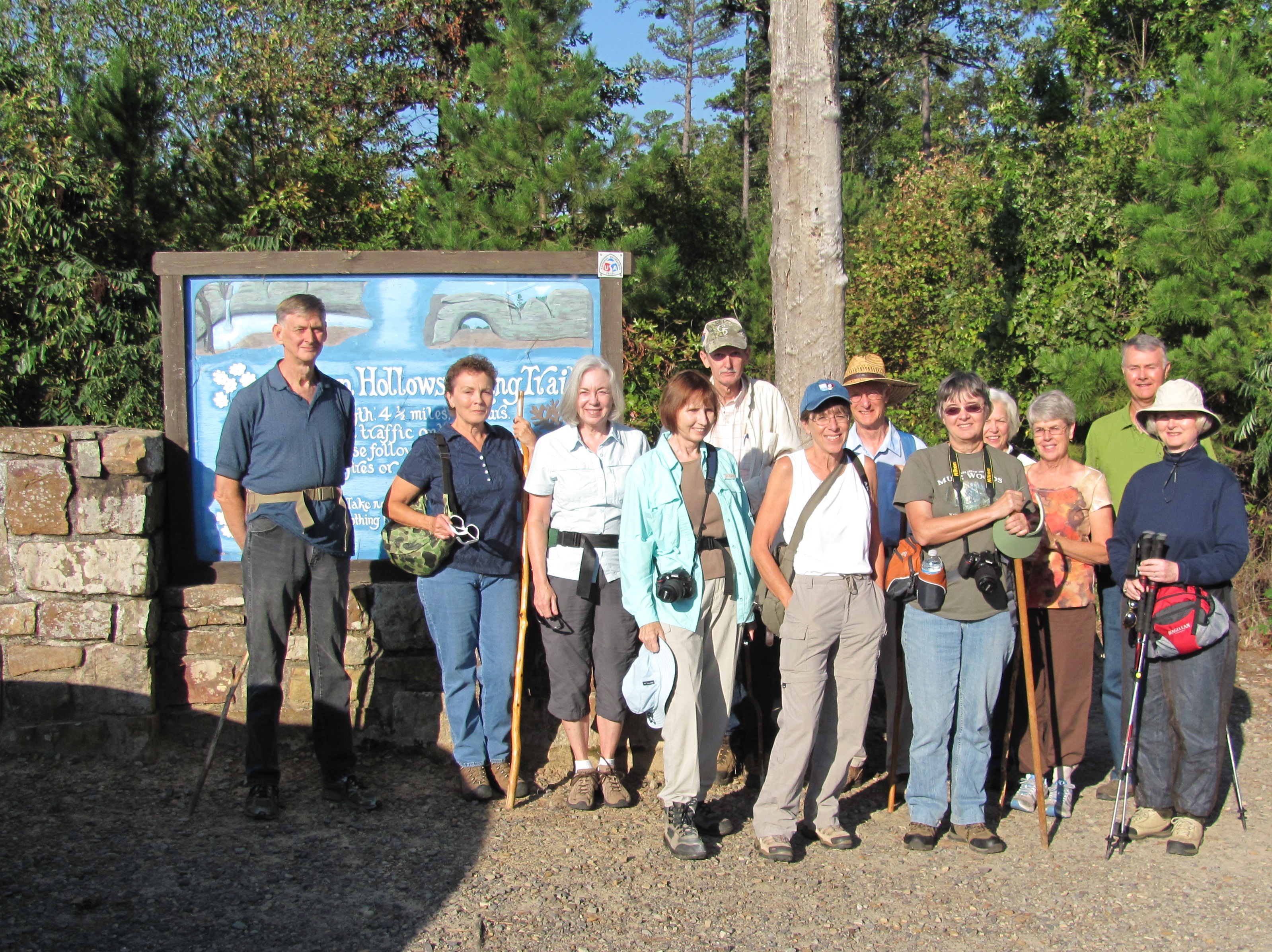
Accompanied by the gentle, constant pitter-patter of variable oakleaf caterpillar droppings, thirteen Arkansas Native Plant Society (ANPS) members ventured into the wilds of Natural Bridge Hollow on Petit Jean Mountain on October 4th.  The mid-morning temperature was perfect for four hours of nearly sweat- and bug-free adventure led by Don Higgins, author of this article.

Led (and I use the term very loosely) by yours truly, Don Higgins, the Thursday hikers included Don and Lynda Ford, Sid and Jeanette Vogelpohl, David Forst (Jeanette’s brother), Martha Bowden, Ellen Repar, Becky Moran, Sherry Ferguson, Margaret Malek, Lynna Schonert, and Eric Sundell. Photo by Don Higgins

I wanted to show the group a couple recent finds of Ozark Chinquapin (Castanea pumila var. ozarkensis or Castanea ozarkensis, as people prefer), so we took our time and stayed within the drainage of Natural Bridge Hollow, which is the eastern portion of Petit Jean State Park’s popular Seven Hollows Hiking Trail. It’s not just an area of stunning natural beauty, it’s also home to several documented archeological sites spanning prehistoric and historic activity.

The Hollows are a series of more or less parallel canyons running southwards on the west end of Petit Jean Mountain. Geologically, the topography resulted from the dissection of the Mountain’s caprock of Hartshorne sandstone. Thus everything derives from quartz, clay, and organic matter; there’s absolutely no limestone here as there is north of the Arkansas River in the Ozark plateau.

Visible caprock/bedrock layers on Petit Jean, photo by Sid Vogelpohl

Sandstone and shale layers conduct water to never-failing springs at several places in the hollows. Plants higher on the caprock sometimes have to endure near desert conditions, especially this year.

Prehistoric activity here is traced by the presence of red ocher pictographs and engraved petroglyphs adorning sandstone shelters. Prohibition brought “industrial activity” to the area, in the form of numerous moonshine stills. After Arkansas’s first state park came into being in 1923, the National Conference on State Parks sent its field secretary, Raymond Torrey, to Petit Jean in 1926, and one of his earliest observations to appear in the Arkansas Gazette, was the following: “Of more recent human interest were plain indications that some of the caves had been used by moonshiners, whose fireplaces, barrels, other utensils and stores of dried, smokeless hickory, remained after the sheriff, in a raid some months ago, destroyed or confiscated the more essential parts of their apparatus.” Now closing in on ninety years later, we ANPS visitors were yet able to spot planks, pipes, barrel hoops, and towing equipment among the refuse left behind by the ’shiners. Across the creek at one spot we found a cleverly walled-in cavern constructed to hide such an operation from even the keenest Revenuer’s eyes.

Across the creek at one spot we found a cleverly walled-in cavern constructed to hide such an operation from even the keenest Revenuer’s eyes. Photo by Don Higgins

But, as always in these hollows, the variety and number of plants were a major attraction. With the odd situation of spring-like weather following a dry, hellish summer, many flowering plants were fooled into thinking they needed to start reproducing. The star of the show for me was a thirty-odd foot Ozark chinquapin. Plentiful in the 1950s, I only know of four of these trees on the Mountain now, and none produces burrs. Perhaps, since there are at least two in this particular hollow, when the second reaches flowering age there may be some nuts produced—providing, of course, that the chestnut blight doesn’t get them first.

After a couple hours of cussing and discussing tricky species, and agreeing on many others, we emerged from the canyon with the chinquapins and hit the main trail again. The hardier of us turned right and continued along the 4.5 mile loop, while those of us who were ready for lunch turned left and headed for the newly-refurbished Mather Lodge for a satisfying lunch.

Hikers Martha Bowden, Don Ford, and Eric Sundell were kind enough to share lists of some of the most interesting plants they noted:

Grasses – Pink, diffuse purple lovegrass (Eragrostis spectabilis) and darker, denser, purpler purple top (Tridens flavus), both in flower with wind-pollinated anthers dangling. Three species of bluestem grass: little bluestem (Schizachyrium scoparium), big bluestem (Andropogon gerardii), and the weedy broomsedge (A. virginicus). River oats (Chasmanthium latifolium) coming into fruit and a variety of panic grasses.

Shrubs – A lot of serviceberry/sarvisberry (Amelanchier arborea), but no large specimens and none with fruit. A profusion of beautyberry (Callicarpa americana), the purple berried variety. Farkleberry, high-bush blueberry (Vaccinium arboreum). New Jersey tea (Ceanothus americanus), the he-huckleberry, maleberry (Lyonia ligustrina) and possibly a mayberry, Elliott’s blueberry ( Vaccinium elliottii), though this sighting is somewhat in doubt as the elliotti usually doesn’t grow that far north.

Trees – Both winged and smooth sumac (Rhus copallinum and Rhus glabra) together on sunny upland and in the woods, fragrant sumac (Rhus aromatica). Ozark chinquapin (Castanea ozarkensis), up to 30 feet tall. Fringe tree (Chionanthus virginicus) and sassafras (Sassafras albidum), Mexican plum (Prunus mexicana) with unripe fruit. Under the cliff, on the walk to the chinquapin and bootlegger hideaway, very large specimen trees of red maple (Acer rubrum), black gum (Nyssa sylvatica), white oaks (Quercus alba) loaded with caterpillars and northern red oaks (Quercus rubra). Dogwoods loaded with fruit.

Ladies tresses orchid, probably Spiranthes cernua. Photo by Martha Bowden

Wildflowers – Rushfoil (Croton willdenowii/Crotonopsis elliptica) abundant in upland glades, accompanying the bluestem grasses. Blue sage (Salvia azurea), alumroot (Heuchera sp.), long-bracted wild indigo (Baptisia bracteata). Several goldenrods in flower, the most common old field goldenrod, (Solidago nemoralis). A small patch of fragrant goldenrod, (S. odora), with licorice-scented leaves when crushed. Ladies tresses orchid, probably (Spiranthes cernua). Leaves of crane-fly orchids (Tipularia discolor) just up out of ground for its active winter season.

Elephantopus tomentosus, devil’s grandmother. Photo by Don Ford

Elephant’s foot (Elephantopus tomentosus) or devil’s grandmother, under low-hanging ledge where it suggested very small elephants. Dittany, known as wild oregano (Cunila origanoides) in flower.

Flowering spurge (Euphorbia corollata) still in nice flower and fruit. Spiderwort (Tradescantia sp.), milfoil (Achillea millefolium), butterfly pea (Centrosema virginianum), bee balm (Monarda sp.), and a species of Ranunculus.

Pineweed or Orangeweed, Hypericum gentianoides. It did have a citrussy aroma. Photo by Martha Bowden

Two species of small, annual Hypericum, nearly leafless orangeweed (H. gentianoides) and nits-and-lice (H. drummondii).   The orangeweed’s leaves produce an orange aroma when crushed. Hawkweed (Hieracium gronovii), a fuzzy dandelion-like composite with bright yellow heads.  White snakeroot (Ageratina altissima), slender or narrowleaf mountain mint (Pycnanthemum tenuifolium). Rough blazing star (Liatris aspera), one with a gulf fritillary.

Liatris aspera, rough blazing star. Photo by Martha Bowden

Several asters were in flower, the most common, Aster patens AKA Symphyotrichum patens. Hemiparasitic lousewort or wood betony (Pedicularis canadensis).

Vines – Vines of interest included cross vine (Bignonia capreolata) and the much smaller partridge berry (Mitchella repens) in two-eyed fruit and once with a pair of flowers.

Ferns – Several ferns, including southern lady fern (Athyrium filix-femina var. asplenioides), Christmas fern (Polystichum acrostichoides), common woodsia (Woodsia obtusa), and a grape fern (Botyrichium dissectum forma dissectum) with a fertile stalk. Grape fern, like the crane’s fly orchid, goes underground for the summer, but was up and thriving for the winter season.

Editor’s note.  Don Higgins lives on the mountain, exploring and learning about the history.  He is an ANPS member who loves this trail and knew we would have a great experience exploring the hollows.  We appreciate his leading this hike.

Terms of use

Posted in Field Trips | Tagged , , , , , , | Leave a comment

Invasive Removal at Pruitt

On the sunny autumn morning of November 7th, seven volunteers gathered at Pruitt to help CD Scott of Buffalo National River remove the invasive rose of Sharon, Hibiscus syriacus, from areas near the native and globally threatened Alabama snow-wreath, Neviusia alabamensis.

Alabama snow-wreath is native to only a few southeastern US states.  Rose of Sharon, not native to the US, has been listed as invasive in the states of KY, PA, TN, and VA.  It spreads by suckers and seeds, and is of little use to wildlife.  However, as settlers brought the plant into this area, it is considered to be of “cultural significance.”  Therefore, using pruning sheers, pickaxe, and saws, we removed rose of Sharon only from areas where it was crowding Alabama snow-wreath.  Where stumps were too large to dig out, CD sprayed them with the herbicide, garlon.  Plenty more rose of Sharon exist and are spreading in nearby natural areas along the riverbank, but the Alabama snow-wreath has been given space to thrive for a few more years.

Represented among the Buffalo National River Partners volunteers were members of Arkansas Native Plant Society, Arkansas Audubon, and the Ozark Society.

Report and picture submitted by Pam Stewart.

Buffalo National River Partners web site: http://bnrpartners.org/

USDA plants database line to Alabama snow-wreath: http://plants.usda.gov/java/profile?symbol=NEAL

Posted in Community Event | Leave a comment

Neat Plant Alert – Viola pedata

Viola pedata (Showy Bird’s Foot Violet) by Eric Hunt

Eric Hunt, an ANPS member from Little Rock, captured this Viola pedata on September 30, 2012 near Cantrell/Highway 10.  The Showy Bird’s Foot Violet is usually a spring bloomer, but is not above trying its luck at fall reproduction.

ANPS botanical expert Eric Sundell says, “Most violets bloom in fall with asexual, self-pollinating, apetalous (no petals) flowers; the flower buds hardly open at all, but seeds develop in rather typical capsules. Viola pedata is taxonomically distant from other stemless violets. A lot of spring-flowering things are blooming this fall, confused by the drought that put them into dormancy and now fooled by mild, wettish weather. “

North America has a huge number of native Viola species.  The USDA Plant Database lists 30 different varieties of violets that have been identified in Pulaski County, AR.  From rocky and dry to moist and rich a violet variety thrives in almost every environment.  Viola pedata prefers soil that is a little dry (at least well drained) and usually fairly poor.   They typically do not respond well to being in a moist, rich garden environment.

Showy Bird's Foot Violet color variations

Viola pedata color variation, by Sid Vogelpohl

Bird’s Foot Violet can be found in a huge variety of colors.  Variations occur frequently, even within colony groups.  Hybridization is thought to play a big role in producing this variety.   Viola pedata is the listed as host plant for the Regal Fritillary Speyeria idalia.  Like most violets, the flowers and foliage of the Showy Bird’s Foot Violet is edible.

Thank you Eric, for your sharp eye.  And thanks to both Eric and Sid for sharing your photographs.

by John Perrin ANPS

Links to more information.

The Ethnobotanical Uses of the Genus Viola by Native Americans
written by Scott D. Appell  published in The Violet Gazette, Summer 2000

USDA Plants Profile for Viola pedata

Lady Bird Johnson Wildflower Center on Viola pedata

Terms of Use

Posted in Native Plants, Plant Alert, Wildflowers | Tagged , , , , , , , | Leave a comment

Audubon Natural History Workshop Weekend

Don Culwell teaches in the field.

What do birds, insects, trees and flowers have in common?  On September 22-23 of 2012, they were each the topic of a workshop sponsored by the Arkansas Audubon Society.  Held at the Ferncliff Presbyterian Camp and Conference Center, just west of Little Rock, the four workshops attracted approximately four dozen participants.  Many were from Arkansas Native Plant Society and many were from the Arkansas Audubon Society.

The workshops are offered to give participants a deeper understanding of the natural world and teach them some skills that may lead to further enjoyment. Fall Wildflowers was taught by Don Culwell, Insects in the Scheme of Things was taught by Cheryl and Norman Lavers,  Arkansas Tree Identification by Eric Sundell and Birding Basics was taught by Dan Scheiman.

Luke Trail sports many varieties of trees

Both days were divided into classroom, lab and field work.  Two lovely meals were prepared each day by our Ferncliff hosts.  The complex includes rentable cabins which gave folks the option of spending Saturday night on sight.

Imperial Moth Caterpillar, photo by Martha Bowden ANPS

Saturday evening after dinner, the insect experts (the Lavers) presented a bonus feature on caterpillars.  That very day, our interest in the topic was piqued by a special celebrity guest.  Some said that only his mother would think he was cute.

In the classroom, the instructors covered their topics with a variety of lecture and lab.  Some of us learned some botany, some learned a little entomology and some a bit of ornithology.  Each of the classes delved in to their subject by familiarizing attendees with reference material and tools of the trade.  Magnifiers of things near and far, notebooks, tweezers and the essential identification key were some of the tools covered in lab.  For our field work, we headed to the great outdoors.

Naturalist Road Trip, captured by Martha Bowden ANPS

Ferncliff has many nice trails and covers a diverse variety of terrain and habitat.  On the trails and around the lakes,  birds and insects were sought out, observed and identified.  Plants were examined, dissected and their botanical families were inferred.   Trees were identified, bark was sniffed and twigs were chewed.  Great fun was had by all.

by John Perrin ANPS

Terms of Use

Posted in Community Event, Workshops | Leave a comment

Gardening with Arkansas Native Shrubs

Learn secrets of how to garden successfully with Arkansas native shrubs, Tuesday, September 11 at noon at Central Arkansas Library System – Adolphine Fletcher Terry Library (2015 Napa Valley Drive) in west Little Rock.

Dr. Eric Sundell, founding member of the Arkansas Native Plant Society and retired Professor of Biology with the University of Arkansas at Monticello, will be the speaker. Bring a sack lunch. Drinks and desserts will be provided.

Call the library at (501) 228-0129 for directions or more information.  No reservations needed.

Leave a comment

Neat Plant Alert – Yellow False Foxglove by the Road is a Super Find

Yellow False Foxglove was seen blooming along Lawson Road (just east of the concrete plant) in Little Rock by one of our Arkansas Native Plant members.  He stopped, took pictures and got them to us for a “neat plant alert.”  And even neater than usual because there has been so little rain!

Flowers of smooth false foxglove, Aureolaria flava, one of three species in Arkansas.
Photo courtesy of Don Ford

Yellow false foxgloves are some of our showiest, most spectacular wildflowers, with 2-3 inch tubular corollas that are worked by large bumblebees. They are especially impressive coming into bloom, as they do, in the late summer, when about the only color left in the landscape is provided by the sunflowers, asters, and goldenrods. The genus Aureolaria comprises only eleven species, all North American, with ten species in the eastern U.S. and one in Mexico.

Photo courtesy Don Ford


Plants are green and photosynthetic, however, they are hemiparasitic, mostly on the roots of oak trees, from which they draw both water and mineral nutrients.  This year, they’re blooming cheerily after one of the hottest and driest summers on record—a feat made easier, perhaps, by their ability to siphon water from the oaks. The false foxgloves have recently been removed from the figwort family, the Scrophulariaceae, and reclassified in the broom rape family, Orobanchaceae, a group which previously held only root parasites without chlorophyll, like our native beech drops and one-flowered cancer root.

Written by Eric Sundell   See our website for Terms of Use 

Copyright @ 2012 Arkansas Native Plant Society

Posted in Native Plants, Plant Alert, Wildflowers | Tagged , , , , | Leave a comment

October 24, 2012, Field Trip to the Champion Trees of Mount Holly Cemetery

Arkansas Native Plant Society Field Trip on Wednesday, October 24, 2012 at 10 am.

Eric Sundell will lead a leisurely botanical stroll in Little Rock’s historic Mount Holly Cemetery, where several of the splendid shade trees are thought to date back to the cemetery’s origin in 1843. Known as the Westminster Abbey of Arkansas, the 20 acre cemetery is the burial site for 11 Arkansas governors, 4 U.S. Senators, 21 Little Rock mayors, the poet John Gould Fletcher—but according to the Encyclopedia of Arkansas, no botanists.

Folks should park on 13th, enter through the 13th Street gate and meet at the Bell House, a short, straight ahead walk from the entry gate.  Call Eric at 870-723-1089 or email at esundell42@gmail.com to sign up for this walk.  Because of the possibility of a funeral and out of respect for the family, we would go to plan B and only Eric would know that.

Field trips of the Arkansas Native Plant Society are for current and future members (i.e., everyone welcome). Botanists from around the state lead these enjoyable, educational walks. If you are planning to attend, please contact the trip leaders in advance so they will know to expect you: at some locations, there is a limit to the number of people that can be accommodated.

Posted in Field Trips | Tagged , | Leave a comment