Students, Botanist-Teacher Need Native Seeds for Arboretum

NOV. 8, 2011 – A botanist who hopes his students can plant an arboretum of native trees has called upon the members of the Arkansas Native Plant Society to contribute seeds and advice for the project.

Students at Arkansas School for Mathematics, Sciences and the Arts examine plants in Jon Ruehle’s classroom. (Photo by Jon Ruehle)

Students at Arkansas School for Mathematics, Sciences and the Arts examine plants in Jon Ruehle’s classroom. (Photo by Jon Ruehle)

“We would like to grow a representative selection of deciduous and some evergreen trees from seed where possible,” Jon Ruehle, Ph.D., of the Arkansas School for Mathematics, Sciences and the Arts in Hot Springs, said. “Our immediate need is for sources of native Arkansas tree seeds to get started. Any help you may care to provide, or any direction to help you may offer is greatly appreciated,” he wrote in an e-mail message to Theo Witsell, a society member. The school is a public, residential high school for high-achieving students.

Witsell and Eric Sundell, the society’s president-elect, have enthusiastically encouraged Ruehle’s project. “This is definitely the time for collecting oak and hickory seeds as well as those of black walnut, persimmon, black gum, sugarberry, honey locust, and many others,” Sundell told Ruehle.

Any members who collect tree seeds for Ruehle’s students should send them to Dr. Ruehle at 200 Whittington Ave., Hot Springs, AR, 71901.

Posted in Uncategorized | Tagged , , , , , | Leave a comment

At Murray Park, an Osprey Eyed Hikers Who Eyed the Crimsoneyed Rosemallow

Nov 4, 2011 – Murray Park, on the south bank of the Arkansas River in Little Rock, offered many sights when Eric Sundell led two groups of native plant enthusiasts on walks there during the fall meeting of the Arkansas Native Plant Society.

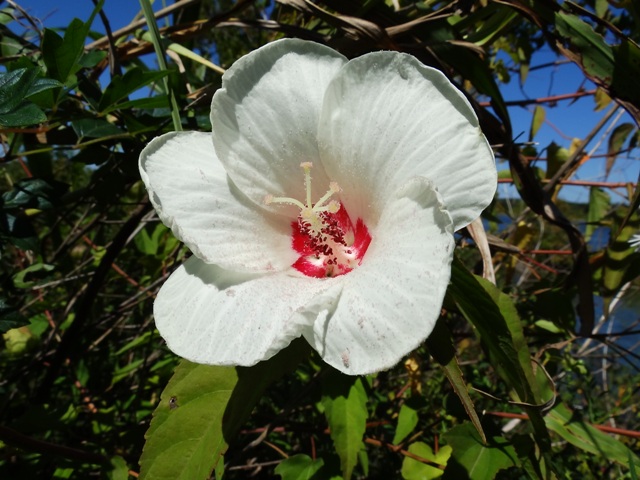
Halberdleaf rosemallow (Photo by Randall Adams)

Halberdleaf rosemallow (Photo by Randall Adams)

Six people joined Sundell, a botanist and president-elect of the society, on the morning walk on October 1; 13 met him for the afternoon stroll. An osprey (Pandion haliaetus) appeared for one group and Pam and Jack Stewart and Bill and Devon Hollimon identified it.

Sundell compiled the following list of species with observations that he and the other hikers made.

Aster, annual (Symphyotrichum subulatus)—In bloom along the shore near boat ramp.

Balloon vine (Cardiospermum halicacabum)—Air-tight, inflated fruits about the size of golf balls that disperse by wind and water; in the mowed area the vines straggled over the ground, and the balloons popped underfoot.

Coffee weed; hemp sesbania (Sesbania herbacea)—An extraordinary, annual, leguminous herb to as tall as 10-12 feet; invasive in low, open habitats; faux trees native to North America, not Wonderland; the roots are loaded with nodules of nitrogen-fixing bacteria.

Cottonweed, plains (Froelichia floridana)—Tall, slender, and elegant native of the pigweed family; we saw this cottonweed last year in the Chidester sandhills.

Cottonweed, slender (Froelichia gracilis)—Weedier, more spreading than the former; in the border of the parking lot.

Frog fruit (Phyla nodiflora)—A ground-covering vine with small, pretty flowers.

Golden-aster (Heterotheca subaxillaris)—A DYC (“durn yellow composite”) with a camphor-like smell; common, weedy, showy, native.

Heliotrope, Indian or turnsole (Heliotropium indicum)—Supposedly from Brazil, so the “Indians” of the common name would be Native Americans, but now a worldwide weed of warm, wet habitats like sand, gravel, and mud bars, with blue flowers arranged in what used to be called a “scorpioid raceme” (because the cluster unrolls from the tip like a fern fiddlehead, suggesting a scorpion’s tail), but the terminology police raided the glossaries and replaced “scorpiod raceme” with the technically correcter “helicoid cyme;” large plants on the slope above the boat ramp were loaded with flowers, fruits, and butterflies.

Hornpod or miterwort (Mitreola petiolata)—Formerly tracked by Natural Heritage but, according to Theo Witsell, found in abundance by Bill Shepherd along the Arkansas River and removed from list of tracked species; we found only two plants.

Indigo, false or leadplant (Amorpha fruticosa)—Locally very common; one especially large shrub impressed the morning group even in fruit (rather than flower); Michael Dirr in Manual of Woody Landscape Plants says the species has been in cultivation since the 1700s and many horticultural forms are listed, but he has never seen one in gardens or nurseries.

Lovegrass, red (Eragrostis secundiflora)—The leaves are blue-green, the spikelets reddish as they age; one of a group of deep sand plants on the hill above the river.

Morning glory, ivyleaf (Ipomea hederacea)—With glorious blue, open corollas in the morning that faded to purplish in the afternoon; alien.

Morning glory, whitestar (I. lacunosa)—The native Ipomea with smaller white flowers.

Primrose-willow (Ludwigia leptocarpa & L. decurrens)—Yellow-flowered wetland plants of the evening-primrose family, but without the floral tube of the more upland and usually showier evening-primroses (Oenothera); it’s always fun to see two closely related species of the same genus side by side to compare similarities and differences.

Purslane (Portulaca pilosa)—A native portulaca of sandy riparian areas; pretty magenta flowers observed in the morning but not in the afternoon.

Rosemallow, crimsoneyed (Hibiscus moscheutos)—In fruit only.

Rosemallow, halberdleaf (H. laevis)—In flower and fruit; our two common, native hibiscus bear some of our largest and showiest flowers.

Sandbur (Cenchrus spinifex)—Ouch! Another deep sand cohort, with burs that are best removed from cuffs and shoelaces with pliers.

Scratch-daisy (Croptilon divaricatum)— With cottonweed, sandbur, red lovegrass, and fall witchgrass in a sandy patch on hill; a sometimes delicate DYC.

Sweetscent or stinkweed or camphor weed (Pluchea odorata)—A showy fall composite with purple heads in dense clusters.

Toothcup (Ammania x coccinea)—Fruits and whole plants successively turning red; showy.

Wild bean (Strophostyles helvula)—Twining vine with twisted keel and no doubt an interesting pollination biology: there must be a bug with twisted proboscis out there somewhere, no?

Witchgrass, fall (Digitaria cognata, nee Leptoloma cognata)—Lovely, diffuse, reddish grass in sandy area with sandbur, red lovegrass, cottonweed, et al.; now in the crabgrass genus, representing the triumph of DNA systematics over common sense taxonomy.

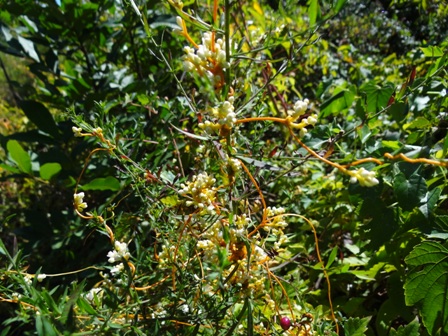
One of several species of dodder known to occur in Arkansas (Photo by Randall Adams)

One of several species of dodder known to occur in Arkansas (Photo by Randall Adams)

As Sundell noted, Murray Park is an interesting mix of wet and dry sites. “The high water table along the river provides fall wildflowers with enough moisture to bloom through heat and drought.” Some locations in the park have deep river sand that supports very different drought-tolerant species and a riparian forest within the park “has large oaks, elms and cottonwoods, a near state-champion sassafras, and a grove of impressively large paw-paws.” A map of the park, which is located a short distance to the east from the new Two Rivers Park Bridge that leads to Two Rivers Park, and the surrounding area is available here.

A selection of morning and afternoon hikes is a typical feature of the society’s biannual meetings. The next meeting will be May 4-6, 2012, in Jonesboro, Arkansas.

Revised:  Nov 8, 2011
Posted in Field Trips | Tagged , , | Leave a comment

Fall Hikers Find Goldenrod and Asters but Trees and Shrubs Are the Stars at Pinnacle Mountain State Park

(Story by Brent Baker)

Updated Nov 5| Blueberries and hawthorns were some of the native plants members found October 1 along Rocky Valley Trail at Pinnacle Mountain State Park during one of the fall hikes of the Arkansas Native Plant Society.

Rocky Valley Trail Hikers (left to right): G. W. Willis, Karen Fawley, Marvin Fawley, Jennifer Ogle, Jack Stewart, Pam Stewart, Isaac Ogle, Sid Vogelpohl, and Brent Baker (Photo by Jeanette Vogelpohl)

Rocky Valley Trail Hikers (left to right): G. W. Willis, Karen Fawley, Marvin Fawley, Jennifer Ogle, Jack Stewart, Pam Stewart, Isaac Ogle, Sid Vogelpohl, and Brent Baker (Photo by Jeanette Vogelpohl)

The group also observed oaks, hickories, and numerous other trees and shrubs along the two-mile trail, which passes through a typical Ouachita mixed pine-hardwood forest on mountain slopes east of Pinnacle Mountain and through riparian forest along the Maumelle River.

The trail begins at the southeastern corner of the upper (eastern) parking lot at the park visitor center, near a pond formed in an old rock quarry. The pond is extremely acidic, due to leaching from the sandstone rock of the mountain, and a vibrant teal color from blue-green algae, one of the few organisms able to survive in such acidic water.

The trail begins as a paved path curving slightly up the hill to the east of the parking lot.  At the top of the hill, a gravel path turns to the right (south), following an old road trace.  Before continuing along this path, the group took a quick detour up constructed stairs to an overlook platform with a spectacular view of the Arkansas River and river valley, Lake Maumelle, and Pinnacle Mountain. Members examined blackjack oak (Quercus marilandica), a scrubby oak typical of dry, sandstone ridges in the Ouachita Mountains, and other dry, ridge-top trees such as black oak (Q. velutina) and black hickory (Carya texana).

Continuing along the Rocky Valley Trail, the group followed the dry ridge top and then turned eastward down a dirt and rock trail and into a northeast-facing slope and valley. Walking through a typical dry, mixed upland Ouachita forest, they saw short-leaf pine (Pinus echinata), black oak; post oak (Quercus stellata); black-gum (Nyssa sylvatica), beginning to show some of its early fall bright red foliage; winged elm (Ulmus alata); and mockernut hickory (Carya alba). Understory trees and shrubs included serviceberry (Amelanchier arborea); parsley hawthorn (Crataegus marshallii), with its characteristically dissected leaves; and American beautyberry (Callicarpa americana), its distinctive clusters of purple berries a vivid sight.

The hikers also observed three native blueberry species: high-bush blueberry (Vaccinium virgatum); farkleberry (V. arboreum), the tallest native blueberry, with arching, somewhat gnarled, branches and a dense dome of dark-green, glossy leaves; and low-bush blueberry (V. pallidum), which is Arkansas’s shortest native blueberry at about two feet tall, often forms dense colonies from underground stems, and has very tasty berries that ripen in early summer.

Continuing down into the valley on the Rocky Valley Trail, the group found that the forest slowly transitioned to a more moist forest with additional hardwood trees and shrubs such as sweet-gum (Liquidambar styraciflua), white oak (Quercus alba), northern red oak (Q. rubra), red maple (Acer rubrum), and flowering dogwood (Cornus florida). Pasture hawthorn (Crataegus spathulata) displayed spoon-shaped leaves and flaking, camouflage-like bark. Hop-hornbeam (Ostrya virginiana) had characteristic dark, shredding bark and papery fruit clusters resembling hops.

At the base of the slope, just above the bank of the Maumelle River, the forest took on a much more riparian character, with Shumard’s oak (Quercus shumardii), water oak (Q. nigra), sugarberry (Celtis laevigata), eastern redbud (Cercis canadensis), sassafras (Sassafras albidum) and understory shrubs of pawpaw (Asimina triloba), possumhaw (Ilex decidua), and rough-leaf dogwood (Cornus drummondii). Musclewood (Carpinus caroliniana), a close relative of hop-hornbeam, had interesting gray, smooth, yet sinewy, trunks reminiscent of rippled muscles. River cane (Arundinaria gigantea), the state’s only native woody grass species, also was present.

Although it was late in the year, following a punishingly hot and dry summer, some keen-eyed folks spotted a few flowers during the hike.  The group admired the arching branches and yellow flower heads of elm-leaf goldenrod (Solidago ulmifolia), the dark purple flower heads of late purple aster (Symphyotrichum [formerly Aster] patens), the bright white petal-like bracts of flowering spurge (Euphorbia corollata), and the four-petal, yellow flowers of St. Andrew’s-cross (Hypericum hypericoides), a small shrub in the St. John’s-wort family.

The Rocky Valley Trail loops back up the visitor center parking lot. Hikers can take an additional one-mile round-trip detour from about the mid-point of the Rocky Valley Trail loop at the base of the valley. This East Quarry Trail spur ascends the steep hill to the east to an old quarry site and another spectacular scenic overlook.

Some portions of Rocky Valley Trail are considered easy but others may be difficult. Allow at least two to two and half hours to fully enjoy the Rocky Valley Trail and the scenic overlook spurs. A map and more information about the trail are available here.

A selection of morning and afternoon hikes is a typical feature of the society’s biannual meetings. The next meeting will be May 4-6, 2012, in Jonesboro, Arkansas.

Editor’s Note: Brent Baker, a botanist with the Arkansas Natural Heritage Commission, led the October 1 Rocky Valley Trail hike.


Posted in Field Trips | Tagged , , , | Leave a comment

Fall Kingfisher Hike a Slow Journey with Many Sights at Canopy and Ground Levels

Story by Burnetta Hinterthuer

Since I had never been on the Kingfisher Trail at Pinnacle Mountain State Park, my sister and I scouted the trail before I led this hike. Even though she told friends afterwards that she had hiked miles and miles, I figured it was less than the quarter-mile given on a map. Eric Sundell had told me that he held the record for taking 2.5 hrs to walk the trail on a group hike years before, so I expected to finish the Kingfisher with enough time left to hike along the river to see shellbark hickory trees. However, our group took three hours to complete the Kingfisher Trail and it was noon instead of the suggested ending time of 11:30 a.m., so we did not visit the shellbark hickories.

Waiting for prey, a praying mantis lurks on an ironweed leaf. (Photo by Ray Erickson)

Waiting for prey, a praying mantis lurks on an ironweed leaf. (Photo by Ray Erickson)

In trying to recount our hike, it seems like a blur. I have no idea how it took us three hours; perhaps Kingfisher is some kind of time warp. Well, after all, that is what avid plant fanatics do: we enter the time warp of a particular environment and start to notice its inhabitants. (Ray Erickson took photos and they are proof that we stopped to observe animal and fungi inhabitants as well.)

Burnetta Hinterhaurer (third from right) confers with Peggy and Michael Burns (right) while other hikers listen closely. (Photo by Ray Erickson)

Burnetta Hinterhaurer (third from right) confers with Peggy and Michael Burns (right) while other hikers listen closely. (Photo by Ray Erickson)

The morning of October 1 was beautiful, sunny but not too hot. Eight people showed up for the hike:  Dewayne and Cindy Hancock, Ray and Linda Erickson, Maury and Barbara Baker, and Mike and Peggy Burns. The trail begins at the parking lot and winds through a bottomland woods. The wildflowers were not in abundance, but they were scattered throughout.

Yellow wingstem with a skipper butterfly (Photo by Ray Erickson)

Yellow wingstem with a skipper butterfly (Photo by Ray Erickson)

The most obvious along the trail was the yellow wingstem (Verbesina alternifolia). A few asters, Drummond’s aster (Symphyotrichum drummondii) and possibly calico aster (S. lateriflorum) were observed. (From a distance, we thought the purple was a perennial phlox; Ray, whose eyesight must be a little better, insisted it was not and went across the Little Maumelle riverbed to get a specimen. He also got a shot of a skipper on the flower.) Tall ironweed (Vernonia gigantea) was found in the streambed along with the largest population of cardinalflower (Lobelia cardinalis) that I have ever seen. Chinese yam or air-potato (Dioscorea polystachya) was hanging off an understory tree and one small tuber was visible. Perhaps the dry weather influenced the size of the tuber because it would have been hard to feed our group on this small one.

We gave each blooming specimen our attention but it was the canopy that grabbed our attention once we got close to the river. A large population of cherrybark oak (Quercus pagoda) stretched into the canopy at what we estimated at 70 feet. (I had only seen one specimen at Rush on the Buffalo River.)

Cypress  (Photo by Ray Erickson)

Cypress (Photo by Ray Erickson)

Continuing on the trail to where it parallels the Little Maumelle River, we saw some bald cypress (Taxodium distichum var. distichum) that probably were 50 feet and taller, on the bank. One tree we encountered was hollow and a person could actually fit into the cavity. Numerous cypress knees gave the scene a surreal quality. These features have long confused botanists as to their function. For a long time, it was thought that they were aerial roots, similar to those of mangroves, which provide oxygen to the bald cypress during times of inundation; however, that has been disputed in recent years. The knees are now thought to help stabilize the large trees that grow in muddy soil.

 Cypress knees (Photo by Ray Erickson)

Cypress knees (Photo by Ray Erickson)

Our group observed understory trees including American bladdernut (Staphylea trifolia), with many bladders, and hophornbean (Ostrya virginiana). Alabama supplejack or rattan vine (Berchemia scandens) was common in the area, its smooth twisted vines ominously wrapped around other trees.

American bladdernut (Photo by Ray Erickson)

American bladdernut (Photo by Ray Erickson)

The hike was very interesting and the company pleasant and knowledgeable. It appeared that this trail, being very accessible and so close to Little Rock, gets lots of traffic. A map of the trail and the area is available here. We were all delighted to run into a group of Arkansas 4-H members picking up litter. There were about six in the group with one being four years old. They were delighted at finding trash to pick up and the trail was very clean. It was also heartening to see so many young couples taking their children to walk in nature on one brilliant fall morning.

The Arkansas Native Plant Society organizes field trips throughout the year. Check the web site often for announcements of upcoming trips.

Editor’s Note: Burnetta Hinterthuer is an instructor in botany at Northwest Arkansas Community College.

Posted in Field Trips | Tagged , , , | Leave a comment

Threebirds Orchid One of August Delights on Kings River Falls Hike

(Story by Burnetta Hinterthuer)

OCT. 30, 2011 | While driving Highway 16 on August 28, 2011, I noticed white flowers     blooming along the highway but couldn’t get a really good view of them. Slowing down, I realized that they were flowering spurge (Euphorbia corollata) putting on a really big show, one of the best displays I have ever seen that species make.

When we arrived at the parking place, there was a crowd already! It was hard to believe people wanted to come out on an August hot day to explore Kings River Falls. It could be that we had just been inside too long this summer, waiting out the 100 degrees heat.  Linda Ellis arrived and then another three carloads of people. This was the best turnout in a long time and it was great to see new faces and meet new plant lovers.

Threebirds (Triphora trianthophora) (Photo by Steve Smith)

Threebirds (Triphora trianthophora) (Photo by Steve Smith)

We hiked upriver, finding the little threebirds orchid (Triphora trianthophora), which is ranked endangered or threatened in some states, although not in Arkansas. There was a fairly large population of the orchid scattered in the low area. We also observed nits and lice (Hypericum drummondii) and seeds of Jack-in-the-pulpit (Arisaema triphyllum) along the trail. There was a bluff with lots of ferns, mosses, liverworts, and Arkansas alumroot (Heuchera villosa var. arkansana) shaded by the small trees that lined the road.

Once at the creek we found red alder (Alnus serrulata), ninebark (Physocarpus opulifolius) Ozark witchhazel (Hamamelis vernalis), plus late summer gravel-bar-lovers roundfruit hedgehyssop (Gratiola virginiana) and sharpwing monkeyflower (Mimulus alatus).

Kings River Falls (Photo by Steve Smith)

Kings River Falls (Photo by Steve Smith)

After we ate lunch, we moved downriver to the Kings River Falls. The sign stated the trail was one half mile long; it seemed a longer, but it was unique in that large boulders were placed along part of the trail to provide flat or sloped surfaces on which to walk; the rest of the trail was sandy and rocky. Sensitive fern (Onoclea sensibilis) was growing in the sand along the trail. We also saw butterfly pea (Clitoria mariana), tall blazing star (Liatris aspera) and a large population of royal fern (Osmunda regalis) on the bank beside the trail. Rick Noyes pointed out a small spikesedge (Kyllinga pumila) that I had never noticed before.

The Arkansas Natural Heritage Commission maintains the Kings River Falls Natural Area in Madison County. A map and more information are available here.

The Arkansas Native Plant Society organizes field trips throughout the year. Check the web site often for announcements of upcoming trips.

Editor’s Note: Burnetta Hinterthuer is an instructor in botany at Northwest Arkansas Community College.

A young hiker collected trash at Dripping Springs to create this art installation. Can you find the hidden word? (Photo by Joe Neal)

A young hiker collected trash at Dripping Springs to create this art installation. Can you find the hidden word? (Photo by Joe Neal)

Most of the hikers took advantage of the pool under the falls to take a cool dip; others put their feet in the water to cool off. It was a great day to be outdoors. (Photo by Steve Smith)

Most of the hikers took advantage of the pool under the falls to take a cool dip; others put their feet in the water to cool off. It was a great day to be outdoors. (Photo by Steve Smith)

Flowering spurge (Euphorbia corollata) (Photo by Steve Smith)

Flowering spurge (Euphorbia corollata) (Photo by Steve Smith)

Hikers saw butterflies puddling. (Photo by Steve Smith)

Hikers saw butterflies puddling. (Photo by Steve Smith)


Posted in Field Trips, Native Plants, Wildflowers | Tagged , , , , , , , , , | Leave a comment

“Bring Nature Home,” Ecologist Tells Society at Fall Meeting

An evening lecture by the popular ecologist Douglas W. Tallamy was standing room only September 30 at the fall conference of the Arkansas Native Plant Society.

Douglas W. Tallamy (left) with Ray Erikson, president of the Arkansas Native Plant Society, and board member Theo Witsell (Photo by Buddy Johnson)

Douglas W. Tallamy (left) with Ray Erikson, president of the Arkansas Native Plant Society, and board member Theo Witsell (Photo by Buddy Johnson)

Using dramatic data, stunning photographs, and a carefully pitched blend of humor and motivation, Tallamy told society members they can help restore biodiversity by using native plants in their home gardens.

The key, he stressed, is to choose native plants that support high numbers of insect species. For example, Tallamy said, black cherry (Prunus serotina) and redbud (Cercis canadensis) both are native to a large area of the United States, but black cherry can support up to 456 species of butterflies and moths while redbud only supports 19 species. (Tallamy ranks the insect productivity of many native and non-native species of woody and herbaceous plants in tables that are available here.)

Tallamy is the author of Bringing Nature Home (Timber Press, 2007) and an ecologist at the University of Delaware.

Introducing Tallamy, Theo Witsell, a board member and a botanist with the Arkansas Natural Heritage Commission, moved the audience with the story of his own realization that in choosing native plants he was “not merely planting a flower garden but creating an ecosystem.”

The plant sale before Tallamy’s lecture was popular, too. (Photo by Buddy Johnson)

The plant sale before Tallamy’s lecture was popular, too. (Photo by Buddy Johnson)

Faulkner County Master Gardeners, Wild Birds Unlimited, and Audubon Arkansas co-sponsored Tallamy’s lecture. Pine Ridge Gardens, Joyce Hardin, and Jane Gulley also supported his appearance. The University of Arkansas Cooperative Extension Service provided the auditorium as well as an outdoor area for a plant sale.

Revised Oct. 18, 2011


Posted in Chapter Meetings, Community Event | Tagged , , | Leave a comment

Yellow False Foxglove in Bloom at Bell Slough during Fall Meeting

This gallery contains 4 photos.

OCT. 10, 2011 | Society members on one of the fall hikes of the Arkansas Native Plant Society found yellow false foxglove (Aureolaria flava) in bloom at the Bell Slough Wildlife Management Area.

“This is the first time we did a fall nature walk identifying herbaceous plants at Bell Slough,” Dave Danner said. “The group identified 11 new fall-blooming wildflowers and three new woody plants. Yellow false foxglove was a personal favorite.” Larry Price, who led the walk with Martha Bowden, pointed out anglepod milkweed (Matelea gonocarpus), a food source for migrating Monarch butterflies. Continue reading

More Galleries | Tagged , , , , , ,

White Oak Bayou Walk

Arkansas Native Plant Society members, along with Central Arkansas Master Naturalists, are invited to take a walk in the White Oak Bayou Wetlands (WOB), Pulaski County.  Date for the walk  is Saturday, October 15 at 9 am to 10:30 am.  For more information about the walk and to sign up, please click on our Upcoming Events Page – Field Trips and Workshops.

Posted in Field Trips | Leave a comment

Janet mentioned ANPS in her blog “In the Garden with Janet Carson”

Check this out!

“As I write this, the auditorium at the state extension office is packed with people listening to Doug Tallamy talking on bringing nature home—also the name of his book. His photos are really impressive. Tomorrow he repeats this presentation in Conway at the church next to the county extension office. He is talking about the importance of the native plants and insects, birds and animals in the garden and how they have been adapting to the invasion of people and what we can do to make a difference. This is the fall meeting of the Arkansas Native Plant Society. In addition to this seminar, they have a full line up of native plant walks.”

via In the Garden with Janet Carson.

Posted in Chapter Meetings, Native Plants | Tagged , , , | Leave a comment

Champion of native plants will speak here on Oct. 1 | TheCabin.net – Conway, Arkansas

Champion of native plants will speak here on Oct. 1 | TheCabin.net – Conway, Arkansas.  Check out this article in the Conway paper.  If you are a member of one of the sponsoring organizations, your price is only $10.  Tickets purchased at the door.

Posted in Community Event | Tagged , | Leave a comment