Ozark Chinquapin a Notable Find at South Fork Nature Center

By Don Culwell

Arkansas Native Plant Society (ANPS) Charter Member and South Fork volunteer Don Culwell added a few details about the ANPS Field Trip on May 19, 2012, as well as some information about South Fork Nature Center and the Gates Rogers Foundation:

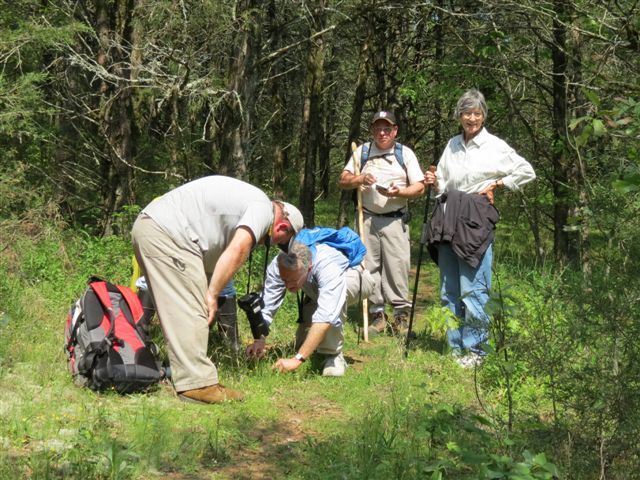
One of the most notable finds on the walk was the Ozark chinquapin (Castanea pumila).  One specimen was growing on the westerly up-side of the trail just above the bluff over the lake near a large mass of farkleberry bushes (Vaccinium arboreum) covering the hillside  The plant was mostly not alive with several six foot, dead branches still well attached in the soil and angling away from the two or three short (10-12 inch) living shoots that were putting out green leaves for the season. Ozark chinquapin is susceptible to the same fungal disease, chestnut blight, that has nearly exterminated the American chestnut (Castanea dentata) from North America’s eastern forests.

Brent uses walking stick to showANPS members where the Ozark chinquapin is growing along the trail.  The red arrow is pointing to the leaves.
Picture courtesy of Martha Bowden

The two miles of pressed gravel trails at South Fork wind around and over the 120 acre peninsula taking visitors along scenic bluff views of the lake and through a variety of ecosystems. Interpretive trail signs alert hikers to the ecology of the area as well as species of birds, insects, amphibians and reptiles, plants, and lichens that can be seen by the careful observer.  The stone entrance to South Fork near Klondike Road is at a kiosk where information and pictures are posted alongside an enlarged map of the area.  Hikers are always welcome to walk the trails at any time and inspect the 100 year old log cabin, the birthplace of noted folksinger Almeda Riddle. When the iron gate is closed (when there is no scheduled activity taking place) visitors may park in the lot opposite the gate. Enter at the kiosk and walk the trails. Bring your own drinks, since no water is available. Picnic tables are found at the cabin as are outhouse toilets.

Visit the website (www.southforknaturecenter.org) for available details and information on activities and plant studies.  Travel time from Little Rock north on Hwy 65 to Choctaw (just south of Clinton) and east on Hwy 330 to Klondike Road to South Fork is approximately one and a half hours.

To view the previous article written about the ANPS field trip on May 19, 2012 click here.

Posted in Field Trips, Native Plants, Trees | Tagged , , , , , | Leave a comment

Snapshots of the Vogelpohl Field Trip on June 2

Article and photos by Sid Vogelpohl

View of Mount Magazine from the Vogelpohl Place (looking south).  The highest elevation of the mountain (2,753 feet above sea level) is Summit Hill shown at left-center.  The Mount Magazine Lodge is below the Summit on the opposite side.

Plants of the Vogelpohl native plant garden observed in photo include woolly lip fern, orange milkweed, dittany, foxglove beardtongue, Virginia creeper, showy goldenrod, scaly blazing star, woodland sunflower, Baldwin’s ironweed and oakleaf hydrangea.

Plants in photo include Christmas fern, hairy lip fern, rock geranium, showy goldenrod, shrubby St. John’s-wort, pussytoes, cutleaf coneflower, American holly, mullein, eastern bluestar and beauty-berry.

Posted in Field Trips | Tagged , , | Leave a comment

A Good Turnout for the Field Trip to South Fork Nature Center, May 19, 2012

Article and photos by Sid Vogelpohl

Standing by the Riddle Cabin at the South Fork Nature Center, Don Richardson and Don Culwell of the Gates Rogers Foundation’s Board, provided a history of the Center as well as future plans.  The Arkansas Native Plant Society field trip, organized by Brent Baker, occurred on May 19th.  Brent helped with a vascular plant inventory for the site which was conducted in 2005.

Participants pause in a bedrock-bottomed stream bed a short distance above Greers Ferry Lake.  A nearby Eastern Hognose Snake, disturbed by all the activity, displayed its head-flattening defense before moving to its safe haven.

For information on the South Fork Nature Center, including its plants and trails, see www.southforknaturecenter.org.

Posted in Field Trips | Tagged , , , , | Leave a comment

Neat Plant Alert – Kentucky Coffee-Tree Near Little Rock Capitol

By Eric Sundell

Photo courtesy of Martha Bowden

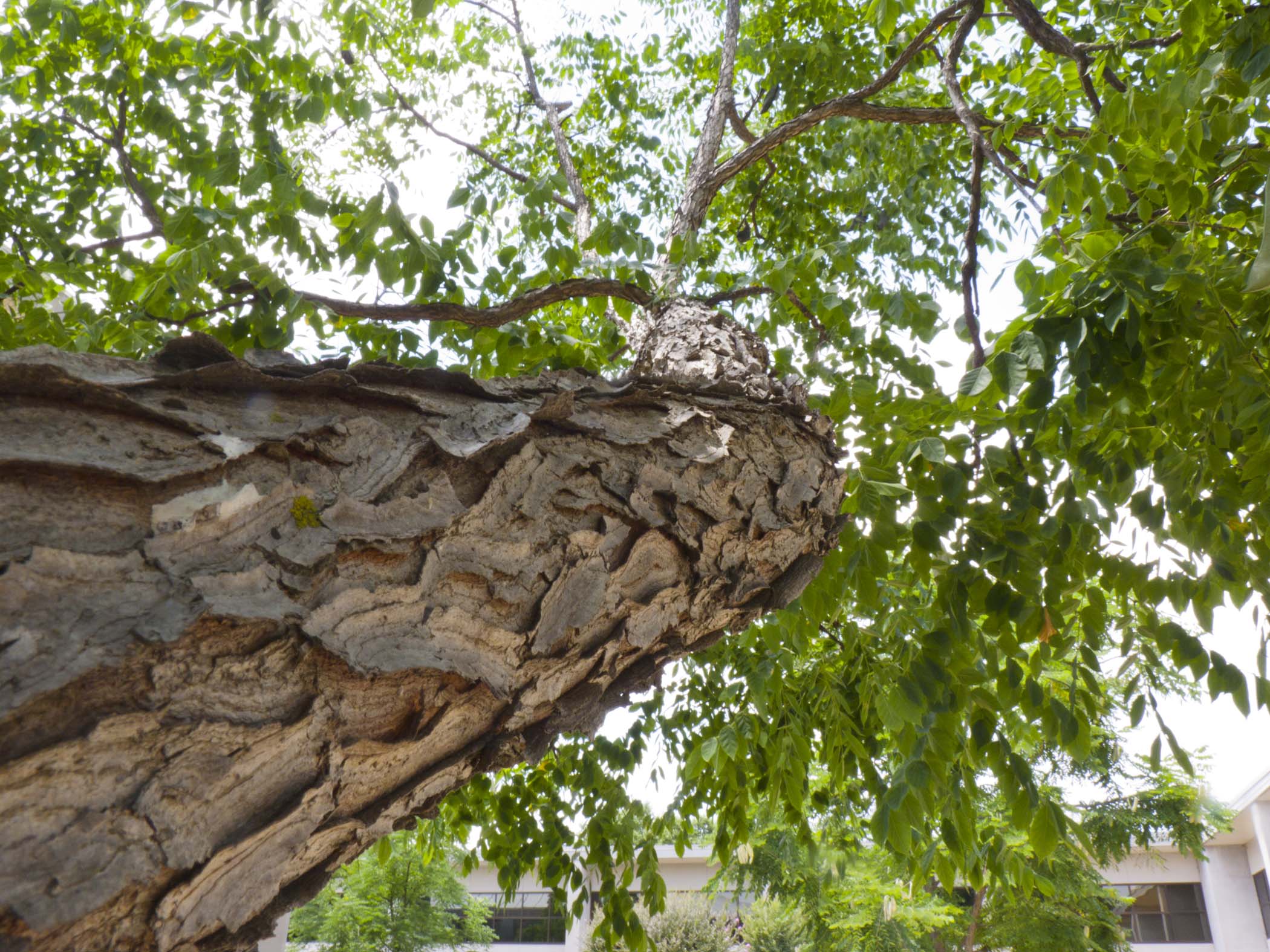
About a dozen Kentucky coffee-trees encircle the Arkansas Supreme Court Building on the south side of the Capitol grounds off 7th Street in Little Rock. Gymnocladus dioicus is an Arkansas native, but not an easy one to find in the wild.

Photo courtesy of Ellen Repar

The trees are spectacular in every way: leaves are 1-3 feet long and doubly compound; bark is fissured and scaly; pods are massive; seeds have been roasted and ground for a coffee substitute (caffeine free) (however, fresh seeds and surrounding pulp are poisonous); even the pith of the stout branches is sensational, orange-brown to a bright orange. According to the Arkansas Forestry Commission’s Steven Burgess, county forester for Pulaski and Perry counties, the trees were planted in the early 1990s.

Photo courtesy of Ellen Repar

Kentucky coffee-trees bear male or female flowers, so you will need to walk around the building to find the two trees bearing fruits. A champion coffee-tree can reach a height of 90 feet with a trunk 3 feet in diameter.

Posted in Native Plants, Plant Alert, Trees | Tagged , , , , , | Leave a comment

Jonesboro Meeting Cool but Too Hot, Too

Our ANPS Spring 2012 meeting drew a good crowd up to Jonesboro and Crowley’s Ridge in northeast Arkansas.

Saturday field trips to Crowley’s Ridge State Park and to the Arkansas Game and Fish Forrest L. Wood Crowley’s Ridge Nature Center were excellent, however with temperatures into the 90s, enthusiasm for outdoor botanizing faded after lunch. Brent Baker—with the help of Meghan Foard and David Burge, graduate students of Travis Marsico, and Jennifer Ogle, graduate student at the University of Arkansas at Fayetteville  —and Eric Sundell led the trips at the state park, Larry Lowman and Travis the trips to the nature center, with Travis’s former colleague at UARK Sarah Nunn and his grad student Kari Harris helping out on the afternoon walk. Larry gave folks a tour of the nature center native plant garden that he had designed for the Game & Fish Commission several years ago. Here are just a few of the memorable plant moments: A waist-high green dragon, Arisaema dracontium, at the nature center.

Kari Harris, aka The Girl Without the Dragon Tattoo, measuring up to a monstrous Green Dragon, Arisaema dracontium
Photo courtesy of Don Ford

Along the Dancing Rabbit Trail at the park, a single perfect specimen of Virginia snakeroot, Aristolochia serpentaria, a small perennial herb in the same genus as the high-climbing, woody pipevine—the flowers bloom at ground level in the leaf litter where several young fruits were developing, and the spicy-smelling roots were used by old timers to flavor their homemade candy.

Virginia snakeroot, Aristolochia serpentaria
Photo courtesy of Martha Bowden

Young fruits of the Virginia snakeroot
Photo courtesy of Martha Bowden

And along the Spider Creek Trail, native wild yam, Dioscorea villosa, with both staminate and pistillate plants in full flower—the foamy sprays of male flowers are especially striking.

Native wild yam, Dioscorea villosa
Photo courtesy of Don Ford

Both of the evening programs scored a perfect ten on the Afflicter Scale, which measures the percentage of audience members asleep by the end of the slide show when the lights come back on. A score of ten indicates that everybody was still awake, and in fact many of them had questions for the presenters. (It was just like teaching undergraduates!)

Larry Lowman gave the Friday evening program, an illustrated talk on the flora and geology of the Ridge, a globally unique landform, with a fascinating mix of common and intriguingly rare plants. For example, yellow-poplar, Liriodendron tulipifera, so common east of the Mississippi River—and the largest hardwood tree in the eastern forest—is native in Arkansas only on Crowley’s Ridge, as is the rare magnolia vine, Schisandra glabra, the genus Schisandra comprising some 25 species, of which 24 grow in eastern Asia and one in eastern North America. (The Sino-American disjunction strikes again!)

Travis Marsico’s program Saturday evening was titled, “Stop and Smell the Roses: They Are Trying to Tell You Something.” The highlight of Travis’s energetic presentation occurred when his film clip of a parasitic dodder vine, Cuscuta sp., seeking a host tomato plant failed to cooperate with the ASU computer projector and could not be screened. Without skipping a beat, Travis shifted to Plan B, personally acting out the role of the dodder and commandeering an audience volunteer, Eric Sundell, to ad lib the part of the tomato plant. The sketch was a big hit. And the fact that it cannot be seen on YouTube suggests that ANPS needs to put more energy into recruiting people who don’t qualify for senior discounts.

Pondberry, Lindera melissifolia
Photo courtesy of Cheryl Lavers

Brent Baker led the Sunday morning trip to the St. Francis Sunken Lands Wildlife Management Area, where about 20 of us admired the world’s largest known population of pondberry, Lindera melissifolia, an Arkansas native shrub on the U.S. Fish and Wildlife Threatened and Endangered Species list. For those of us who live in more or less upland, well drained habitats, the Sunken Lands are an exotic, foreign place, dominated by the most aquatic of Arkansas trees: baldcypress of course, but also overcup oak, Nuttall oak, water oak, river birch, Drummond red maple, green ash, sycamore, American elm, and black gum. The low mounds supported most of the woody vegetation. The swales were black with leaf litter scarcely decomposed under prolonged anaerobic conditions. It was a different botanical world.

By Eric Sundell

Posted in Chapter Meetings | Tagged , , , , , | Leave a comment

A Very Highlight from Crystal Bridges/Compton Garden

Photo courtesy of Burnetta Hinterthuer

The view from Compton Gardens up into the crown of a basswood tree, Tilia americana, that ANPS members on Burnetta Hinterthuer’s field trip (May 13, 2012) estimated to be between 80 and 100 feet high.

Also witnessed were the state champion yellowwood, Cladrastis kentuckea, and the state champion “hybrid chestnut,” a cross between the endangered American chestnut, Castanea dentata, and Chinese chestnut, C. mollissima, a tree frequently grown in Arkansas for its large, delicious seeds.

Yellowwood in flower
Photo courtesy of Martha Bowden

Flowers of the beautiful yellowwood, Cladrastis kentuckea, a lover of sweet (alkaline) soils, uncommon and local in the Southeast and North America’s only species of Cladrastis. Five additional species occur in eastern Asia.

plaque at Compton Gardens

Arkansas Forestry Commission plaque declaring the Compton yellowwood the Arkansas state champion. Trunk circumference = 53 inches, crown spread = 71 feet, height = 55 feet, for a Bigness Index of 126. The species was recently rediscovered in Pulaski County on ledges above Rebsamen Park.

Posted in Field Trips, Ozark Chapter | Tagged , | Leave a comment

Highlights from the Spring Meeting in Jonesboro, May 2012

Crowley’s Ridge Nature Center
photo by Sid Vogelpohl

Larry Lowman, guest speaker, shares his knowledge with Donna Hanke during a field trip to the Crowley’s Ridge Nature Center.  Betty Nichols, in background, maintains the Native Plant Garden as a Master Gardener.

Lindera melissifolia (pondberry)
photo by Sid Vogelpohl

Members on a Sunday field were introduced to the federally listed (Endangered) Lindera melissifolia (pondberry) by Brent Baker.  A close relative is Lindera benzoin (spicebush).

Posted in Chapter Meetings | Tagged , | Leave a comment

Ozark Spring Beauty Caught in the Act High above Cove Creek

Report on Cove Creek Field Trip, March 31, 2012, by Eric Sundell

Arkansas Natural Heritage Commission botanist (and ANPS Past President) Brent Baker’s trip to ANHC’s Cove Creek Natural Area northwest of Greenbrier in Faulkner County—the first walkabout of the new season!—drew a very respectable turnout of 13 ANPS members:  Martha Bowden (Webmaster), Don Crank (Past President), Donna and Bruno Hanke, Becky Hardin and Butch Hinton, Jay Justice (longtime president of the Arkansas Mycological Society), Pat and Sandy Morris, Eric (President Elect) and Milanne Sundell, and Sid (Treasurer) and Jeanette Vogelpohl.

The grand prize of the mile and a half trail loop was to be a look—a first look for many of us—at the Ozark spring beauty growing in ledges and crevices of the sandstone bluffs high above Cove Creek. The plants are not only rare, occurring in just a few known populations in Arkansas, Missouri, and Oklahoma, but their status as a species distinct from Carolina spring beauty was only recently appreciated: Claytonia ozarkensis was described as new to science in 2006. Theo Witsell featured Ozark spring beauty in the Fall 2007 Claytonia, which you can revisit at the ANPS website to see a couple of beautiful and informative photographs of plants in flower. In that article, Theo describes the Eureka Moment when he figured out the astonishing mechanism by which the plants disperse their seeds to sites where they have the best chance to thrive free from the competition of larger species.

“The stems, which had been cascading down from the crevices in March, with the flowers facing out away from the bluffs, were now in full fruit. But the stems had turned around and were stuffing the mature seed capsules back into the bluffs! In many cases the capsules had found cracks and crevices in the bluff and were being inserted right into them.”

Ozark spring beauty (Claytonia ozarkensis)

In Jeanette Vogelpohl’s accompanying photo, this adaptation is nicely illustrated: several of the swelling seed capsules, at the tips of elongating stalks, can be seen ‘hunting’ for a dark crevice in which to open and release their contents, the seeds for the next generation of cliff-dwelling Ozark spring beauties.

Our walk at Cove Creek brought to mind a southern European plant unrelated to spring beauty that has evolved a similar dispersal mechanism for a similar habitat: Kenilworth-ivy, Cymbalaria muralis (the species epithet means “of walls” or “growing on walls”), is a beautiful, fascinating, and, yes, alien weed that occurs wild in Arkansas (to my knowledge) in only one place, Eureka Springs, where it is locally abundant and easily observed clambering over garden walls, rock piles, and even at sidewalk and parking lot borders. There the exquisitely adaptive dispersal mechanism can be examined without the fear of losing your life by toppling over a sandstone bluff. The adaptation is captured in a time-lapse motion picture segment in David Attenborough’s BBC production, “The Private Life of Plants,” Volume 1, on how plants do their traveling.

The Cove Creek loop trail harbored two additional rare plants. Draba aprica, a whitlow-grass of the mustard family, (and one of the most easily overlooked species of flowering plants in the world), is rated G3/S2 (globally vulnerable). If the lovely dandelion can be ignored and even despised because it’s so common, then perhaps ‘open-ground whitlow-grass’ can attract some appreciation for its rarity.

Brent and Eric examining the white clover, Trifolium carolinianum (Photo by Sid Vogelpohl)

The other rare plant was wild white clover, Trifolium carolinianum, a native species superficially similar to but entirely distinct from the abundant lawn and roadside alien, white clover, T. repens. The alien is a stoloniferous perennial, rooting at the nodes; the native is variously described both as annual and perennial, but either way non-stoloniferous. Theo featured wild white or Carolina clover in his article on Arkansas’ native clovers back in the Fall 2009 Claytonia. He observes that the species, which at that time he had seen in the wild only once, in the past had been common: “Nearly all of the known collections are historical, with most made between the 1880s and 1940s, and very few made since the 1950s.” The widespread decline of the native clover, which occurs throughout the Southeast, is a mystery, especially as it thrives on disturbance. Brent Baker pointed out a small population under our feet in the middle of the walking trail and another at the edge of the parking area. We were too early for flowers, but we put our trust in Brent’s keen field eye and added Trifolium carolinianum to our life lists.

Arkansas’ premier mycologist, Jay Justice, noticed the black cup fungus Urnula along the path. My former dendrology students used to call them black roses. Our timing was perfect. Several of us knew how to tickle the cups with a finger to unleash the cloud of spores, but Jay taught us the alternative technique of simply blowing softly across the top of the cups. After the split second delay, a puff of smoke rose into the air. Very cool!

We saw some wildlife: a box turtle & a cottonmouth. But we were out for flowers. And if you’re out for flowers in Arkansas in late March and early April, it’s hard not to have a rewarding walk. We were met by the usual delightful surprises of spring, for example, red buckeye, flowering dogwood, fringe-tree, cross-vine, wild hyacinth, Ohio spiderwort, and fire-pink. For especially photogenic blue, there was blue-eyed-Mary, and bird’s foot violet blooming near the cedars in patches of reindeer moss. Blueberries were everywhere: Vaccinium virgatum (we’re pretty sure it wasn’t V. pallidum) was common, with closed, urn-shaped corollas, and V. stamineum, deerberry, with open, campanulate corollas, was uncommon. Both promised that the future would be sweet. But yellow may have been the dominant theme of the day. Two species of golden ragwort appeared and reappeared, Senecio tomentosus and S. plattensis, both classified now in the genus Packera, but still pretty. Three buttercups with large, medium, and small flowers (also called grande, venti, and tall in the technical literature) accompanied us most of the way: Ranunculus fascicularis, R. harveyi, and R. abortivus. And yellow star-grass was beaming. What a fine trip!

For more information on Cove Creek Natural Area and other natural areas in Arkansas, visit the  Arkansas Natural Heritage Commission website.

Our Join page has information on how you can become a member of the Arkansas Native Plant Society.
Posted in Field Trips, Native Plants, Wildflowers | Tagged , , , , , , | Leave a comment

May 30, 2012, Field Trip to Meyers Creek

Don Crank, John Simpson, and Eric Sundell will lead a field trip to Meyers Creek on Wednesday, May 30, 2012. Meet at Burl’s Smoke House on U.S. Hwy 270 in Crystal Springs (west of Hot Springs) for a 10 a.m. departure. (The smoke house is on the right/north about 300 yards west of jct 270 with the road to Crystal Springs Landing on Lake Ouachita.) We’ll be back at the smokehouse for lunch between 12-1. The site enjoys permanent water from a seep and is rich in ferns, orchids, and a diversity of other flowering plants as well as a canopy of large umbrella magnolias. The walk will not be difficult, but it does involve crossing the creek: wear knee boots or other footwear to get across. Call Don (501-679-5299), John (501-321-0419), or Eric (870-723-1089) if you have any questions and to let them know you are coming!

Field trips of the Arkansas Native Plant Society are for members. Botanists from around the state lead these educational walks. While on the trails, participants may ask questions, take photographs, and learn about the ecology of the area.

Membership information is available here.

Posted in Field Trips | Tagged | Leave a comment

May 4-6 ANPS Spring 2012 Meeting at Crowley’s Ridge in Jonesboro

ANPS SPRING 2012 MEETING

May 4-6, 2012

Crowley’s Ridge – Jonesboro, Arkansas

FRIDAY EVENING, May 4, Arkansas State University Student Union, Spring River Room (Parking in North Parking Deck most convenient)

Registration 4-7 p.m.  Members are reminded that the standard $5.00 registration fee will be charged.

Sign up for Saturday and Sunday walks 4-7 p.m.

Spring Meeting Information update 4/30:  

Iced tea and cookies will be provided by ASU’s Food Services. However, ANPSers are welcome to bring snacks and munchies to supplement. Plant lovers cannot live on tea and cookies alone.

ANPS T-shirts will be available for sale, including two new designs.

Program, 7 p.m.: Presentation by Larry Lowman, “Flora and Geologic Origin of Crowley’s Ridge”

SATURDAY and SUNDAY FIELD TRIPS, May 5 & 6

Morning and afternoon field trips will take place at Crowley’s Ridge State Park and at one or two additional destinations. Locations, directions, times, and field trip leaders will be announced Friday evening. You can also contact Eric Sundell (870-723-1089) for field trip information.

SATURDAY EVENING, May 5, Arkansas State University Student Union, Spring River Room (Parking in North Parking Deck most convenient)

Registration 4-7 p.m.

Sign up for Sunday walk 4-7 p.m.

Spring Meeting Information update 4/30:  

Iced tea and cookies will be provided by ASU’s Food Services. However, ANPSers are welcome to bring snacks and munchies to supplement. Plant lovers cannot live on tea and cookies alone.

ANPS T-shirts will be available for sale, including two new designs. 

Program, 7:00 p.m.: Presentation by Travis Marsico, “Plant Defenses against Insect Herbivores”

Business Meeting to follow presentation

 LODGING for Spring Meeting

ANPS has reserved a block of 30 rooms at a reduced rate at Comfort Suites in Jonesboro. Room charges, including hot breakfast, will be $75 + tax for a King or $80 + tax for two Queens. (Don’t worry—all ANPS members, whether nobility, gentry, or yeomanry, get the same rates.) The motel is located near the junction of US Highways 63 & 49, just south of the ASU campus. Thirty rooms are guaranteed to ANPS at reduced rate through April 23, 2012, however, if rooms are available after that date, we will still be extended the reduced rate.

Comfort Suites
3404 Access Road
Jonesboro, AR 72401
870-336-2280

Membership information is available here.

Posted in Chapter Meetings | Tagged , , | Leave a comment