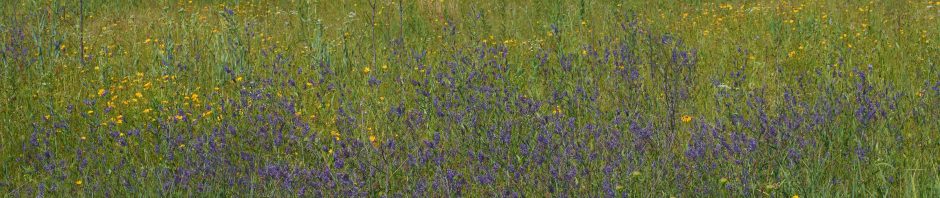
Hairy phacelia (Phacelia hirsuta) of the Borage (Boraginaceae) family [formerly of the Waterleaf (Hydrophyllaceae) family] is a beautiful annual forb with blue flowers. In the U.S., it is found naturally in Arkansas, Louisiana, Texas, Oklahoma, Kansas, and Missouri, as well as introduced in Kentucky and Pennsylvania. In Arkansas, it is found throughout much of the state but sparser in the Mississippi Alluvial Plain. Its habitats include rocky to sandy, moist soils in open woods and woodland margins, as well as in prairies, glades, and along roadsides. The genus name is from Greek for “bundle”. The specific epithet is from Latin for “hairy”. Another common name is “hairy scorpion-weed”.
Hairy phacelia, whose basal leaves appear in late winter, develops a main stem and several long to short secondary stems. The longest secondary stems grow from lower leaf axils of the main stem, with shorter stems growing from mid-stem axils. Plants have a tap root and a few fibrous roots. The main stem and secondary stems reach a similar maximum height of up to 1 to 1½ feet. Stems, which are weakly erect, are yellowish-green with the lower portion having a reddish cast. Stems are very hairy (hirsute).
 Photo 1: In this April 2nd photo, several secondary stems have developed and developing inflorescences can be seen at the ends of stems.
Alternate hirsute leaves, with three to seven leaflets or lobes, are widely spaced on a mature plant and are medium green on upper surfaces and light green on lower surfaces. Leaves feel soft and venation is not especially distinct.
Lower leaves, which have long, grooved petioles, have blades from ¾ inch to 1¼ inch long, with maximum width of about ¾ inch. These leaves typically have a lower lateral pair of opposite, oval leaflets and, higher up the leaf blade, one to three pairs of mostly opposite, lateral leaflets that may have widened bases, becoming lobes. Additionally, a large, broad terminal lobe is partially cleft on both sides so that it is three-lobed. Lower leaflets (or lobes) are set perpendicular to the rachis while upper lobes (including those of the terminal lobe) are angled toward the apex. Lobes of these lower leaves may be wide or narrow with rounded tips.
Upper leaves (from mid-stem into the inflorescence), have blades that decrease in size up-stem to uppermost leaves that may be ¾ inch long and 3/8 inch wide. Transitioning up-stem, lobed leaves gradually change shape from petiolate to sessile and lobe blade tissue increasingly extends along the rachis. The uppermost leaves have two or three pairs of lateral lobes that may be either narrow-rounded and angled toward the leaf apex or narrow-acuminate and out-flared. The shape of terminal lobes is similar to lateral lobes. Petioles of mid-stem leaves (when present) are wide and broadly grooved. Smaller leaves are sessile.
 Photo 2: Leaf display shows changing leaf shape from basal to upper stem leaves (left to right). Note that leaves change from petiolate to sessile and from having some leaflets and lobes to having all lobes.
Inflorescences, in mid-spring, grow from uppermost leaf axils of main and secondary stems. Appearing first as round clusters (or “bundles”) of compacted sepals, with growth, the coiled nature of the inflorescence becomes apparent. Coils consist of a peduncle with up to twenty or more flowers alternately arranged along the upper side of the inflorescence axis (rachis).* Flowers are each on a short pedicel. Peduncles and pedicels have short hirsute pubescence. As the coil straightens, flowers reach anthesis from lowermost to uppermost. When fully straightened and the last flower has bloomed, the inflorescence may be 3 inches long. The entire plant continues to stretch out (grow) until the final flowers have bloomed.
 Photo 3: Developing inflorescence appears as rounded clusters of loose, hirsute sepals at ends of stems.
Flowers, about ½ inch in diameter, have a deeply divided calyx with five long, narrow, spreading lobes with hirsute exteriors, and a bowl-shaped corolla notched to create five broadly-triangular but rounded lobes. The exterior of the corolla is pubescent. Corollas are typically a light blue to lavender overall, but may have a lighter or white center. Just below mid-corolla, ten dark purple, round to three-sided spots encircle the flower’s center, two spots below each lobe. These purple spots are surrounded by a haze of lighter color. Five spreading stamens have white filaments, with anthers at first bearing light yellow pollen that become black. Filaments, adnate at the base of the corolla, are covered by long radiating white hairs. The pistil, also white, has a forked and pointed style whose stigma does not become receptive to pollen until after the pollen from the same flower has been shed (protandry–an adaptation that reduces self-pollination). Stamens and pistils, all about the same length, extend slightly beyond the rim of the corolla. A light green, superior ovary, also hirsute, has the shape of an elongated, round cone.
After producing seed capsules containing a small number of brown seeds, these annual plants quickly die.
 Photo 4: Flowers reach anthesis at the top of a coil in sequence (from left [bottom of coil] to right [top of coil] in this photo) as coil straightens. “Newest” flower at right bears pollen. Forked styles can be clearly seen in the lower two flowers.
 Photo 5: In this May 1st photo, plant is nearing the end of its life cycle. Plant being collected by botanist Eric Sundell (a reviewer of these articles), accompanied by Milanne Sundell.
In addition to hairy phacelia, six other native phacelia species occur in Arkansas. Hairy phacelia is the most common and widespread. Three of the others are rare to very rare in the state and are tracked by the Arkansas Natural Heritage Commission. Hairy phacelia can be distinguished from the other six by several characteristics, including 1) high degree of pubescence and 2) light blue to lavender, bowl-shaped, 10-spotted corollas, 3) stamens and pistils that are only slightly exserted from corolla, and 4) rounded, non-fringed corolla lobes.
Another species in the borage family that can occur in the same habitats as hairy phacelia and with some similar characteristics is “large-flower baby-blue-eyes” (Nemophila phacelioides). It occurs in the west-central part of the state.
- This inflorescence style is referred to as a scorpioid (resembling the coil of a scorpion’s tail) or helicoid cyme which is typical of the borage family and the source of one of the general common names, “scorpion-weed”, for some members of the genus Phacelia.
Article and photographs by ANPS member Sid Vogelpohl
 Photo 1: A partial rhizome and plant (detached from main rootstock at light orange area). This rhizome segment has several branches, including a small branch on the right side.
 Photo 2: A relatively small young plant. Note wide uncleft area at center of leaves as well as flower buds making their appearance (see top center and lower right). White flowers in upper left are those of rue anemone (Thalictrum thalictroides).
 Photo 3: A single pair of cauline leaves subtends an upper secondary stem and two lower peduncles. Note the small leaves on the secondary stem and bracts at bases of stems, peduncles and pedicels.
 Photo 4: Flowers, changing from pink to lavender, have widely flared, overlapping, obovate petals.
 Photo 5: Display showing flower buds (lower right), front and back of flowers and a flower past bloom (lower left). Note five-branched, back-curved stigmas.
 Photo 6: The flower at lower position in display (sepals and anthers removed) exhibits a prominent pistil prior to spreading of stigma. The two fruits (sepals removed) show the closing of the stigma (more mature fruit at top of display), strong growth of their “bills” and enlargement of ovules.
 Photo 7: In this display, the central stem bears a green immature fruit and a brown fruit that is poised to launch its five seeds. Seeds (examples on left) of the other two stems have been launched with caps and arms curled backwards.
 Photo 1: These multiple leaf rosettes are growing from a single caudex. Flowering stems are poised to grow as can be seem on the left side. Photo in late February.
 Photo 2: A flowering stem with widely spaced pairs of leaves on its lower portion. First flowers to open are axillary flowers between two secondary stems, as shown. Note additional stems just appearing.
 Photo 3: Even with a dozen main stems, the inflorescence is very open.
 Photo 4: The corolla and corona are the same vibrant red. As shown, all ten stamens have emptied their anthers of pollen and twisted backwards as stigmas become receptive to receiving pollen from a different flower. Note the enlarged calyx behind the corolla.
 Photo 5: In the flower shown with petals, two sets of five anthers are exserted while styles have not yet appeared. The two flowers without petals show styles emerging with stamens in decline (lower center) and styles fully exerted with receptive stigmas, while stamens have wilted (upper left – note enlarging ovary). A ridged calyx (center) is also shown.
 Photo 6: As calyxes dry, teeth roll back and seeds easily drop out.
 Photo 1: In mid-winter, basal leaves unfurl. Note pubescence of petioles and leaf blades.
 Photo 2: Appearance of trifoliate basal and cauline leaves are similar. Early pubescence is lost as the season progresses. Photo taken at end of March.
 Photo 3: Flower buds, as seen at left as well as in right foreground, suggest the shape of a dolphin, the source of the genus name Delphinium. Sepals and petals of this particular plant are all the same color. Stamens can be seen behind the two lower hairy petals.
 Photo 4: Trifoliate leaves have many elongate, broad lobes with rounded apices. Basal leaves remain vibrant throughout the growing season. Photo taken in early April.
 Photo 5: In early May, follicles are beginning to dry. Trifoliate upper leaves exhibit relatively little lobing.
 Photo 1: This 4-inch seedling, in late January, would already have a long taproot. Seeds in inset were similarly planted outdoors, but had not yet sprouted.
 Photo 2: Terminal and lateral buds produce rapid spring growth. These two stems grew from separate lateral buds at the top of previous year’s growth.
 Photo 3: This plant, only several years old, produced its first inflorescence. Note enlarged reddish bud scales about to fall off and (on the trunk) leaf scars, undeveloped buds and lenticels.
 Photo 4: Opposite leaves typically have five leaflets with pinnate venation and crenulated margins. Note axillary leaf buds for next years’ growth.
 Photo 5: Flowers that are positioned along the upper sides of the clusters. Pistil of a flower is exserted before flower’s stamens appear, as seen at lower left.
 Photo 6: Fertilized ovaries develop into fruit with long, weak spines. Typically, only a few fruits per panicle will reach maturity. Photo in mid-April.
 Photo 7: Upper portion of panicle beyond developing fruit has dropped off in this mid-July photo. Note two opposite brown buds at base of panicle’s peduncle (for next year’s growth).
 Photo 1: Rhizome segment at coin is decaying after producing a flower stalk marked with a red asterisk. Lateral roots grew from either side of dead segment. Taproot is below coin.
 Photo 2: Long, radiating leaves are thin and pliable with a flexible point. Photo taken in late February.
 Photo 3: Curly marginal hairs are not twisted as on some other species. Appreciable stems do not develop as leaf rosettes add new central leaves from year to year.
 Photo 4: In this early May photo, purplish bracts on elongating flower stalk subtend and cover developing flower buds. Bracts are relatively short, as compared to other species.
 Photo 5: Flowers, on short pedicels and peduncles, occur in a raceme-type inflorescence. Bracts on the lower portion of the stalk do not dry while flowers are in bloom. Site shown is mostly shady with loam soil.
 Photo 6: Heavy flowers cause pedicels to bend down. As seed capsules develop, strengthened pedicels bend upward.
 Photo 7: The lobed green style sits above a large ovary that is surrounded by post-like filaments and thick tepals. Honey ants can be seen feeding on flower bud resin.
 Photo 1: Rootstock, as seen in this mid-January photo, bears green fronds which will decline when new fronds appear in late winter . Previous year’s stipes remain. Fibrous roots have been removed.
 Photo 2: In early April, fiddleheads grow from center of rootstock. Previous year’s and older stipes can be seen.
 Photo 3: In early January, fronds remain green. All fronds of a plant grow from center of rootstock without any off-sets.
 Photo 4: Upper surfaces of an infertile frond (left) and a fertile frond (right) appear the same. Lower side of a fertile frond, which has already dispersed its spores, is shown in the middle. As shown, pinnae may be opposite or alternate. Photo taken in mid-July.
 Photo 5: Sori are located at margins of pinnules or singly at sinuses between lobe-like pinnules, as shown. Note venation and slightly crenulate margins. Photo taken in mid-July.
 Photo 6: Marginal wood fern is an excellent accent plant for a shady garden.
 Photo 1: Roots may grow from near leaf nodes or elsewhere from the underside of stems.
 Photo 2: Current-year stem growth shown across upper-center of photo. Angle of petioles changes to orient leaves to sunlight. Note pale midribs of leaves.
 Photo 3: With several years of growth, older stems become covered by newer stem growth and leaf litter. Largest leaves are at base of current season’s growth.
 Photo 4: In this early May photo, flower buds are shown at the top of photo and several flower pairs and calyx pairs are shown lower in photo.
 Photo 5: In this mid-May photo, flower buds are seen along with an open corolla that shows the pin morph of dimorphisim. Note arcuate leaf venation and calyx bearing two corollas.
 Photo 6: In this early December photo, this partridgeberry was growing among moss and lichens near pine trees. Perianth scars remain evident along with calyx remnants, especially in the upper fruit. Inset shows fruit’s interior and stones.
 Photo 1: This dittany plant, shown in late March, bears heart-shaped leaves and has pubescent stems, lower leaf surfaces and leaf margins.
 Photo 2: A lanky plant in bloom in a sunny rocky site. Photo taken in late September.
 Photo 3: Flowers have four rounded lobes, strongly exserted stamens and pistils and exterior pubescence.
 Photo 4: In late November, floral tubes having fallen off and calyxes are accented by white hairs.
 Photo 5: Display shows a cluster of cymes along with a separated 1/8-inch-long calyx and nutlets. Note villous hairs extending out of calyxes.
 Photo 6: A dittany plant with frost flowers in late December. Frost flowers may be “regrown” from an individual stem on successive cold nights.
 Photo 1: From year to year, stems multiply and become crowded. Note lenticels (prominent white corky dots). Green stems on right are a greenbrier (Smilax sp.).
  Photo 2: This mid-April photo shows twigs bearing female (left; note also fruit still remaining from previous season) and male (right) flowers. These male flowers have five petals, which is not typical (usually there are four). Spur shoots lengthen a minute amount each year as flowers and leaves grow from the tips. Note midrib pubescence of leaves on left.
 Photo 3: This third-year twig is developing greyish bark and spur shoots. Flowers have pedicels which grow directly from spur tips. Pistillate flowers may have infertile stamens, as shown (see arrows). Fruit sometimes remains on plant into following growing season.
 Photo 4: With sufficient sunlight on individual branches, fast growing current-year twigs may bear fruit on their lower portion. Photo taken in the mid-July.
 Photo 5: In this mid-October photo, fruit are becoming red. Note texture of very slow growing spurs roughened by leaf and pedicel scars. Inset shows ridged, 1-seeded stones..
 Photo 6: Possumhaw’s fruit is further enhanced by snow and ice. Fruit-bearing shrub at base is corral berry (